05 · selected work
a・count
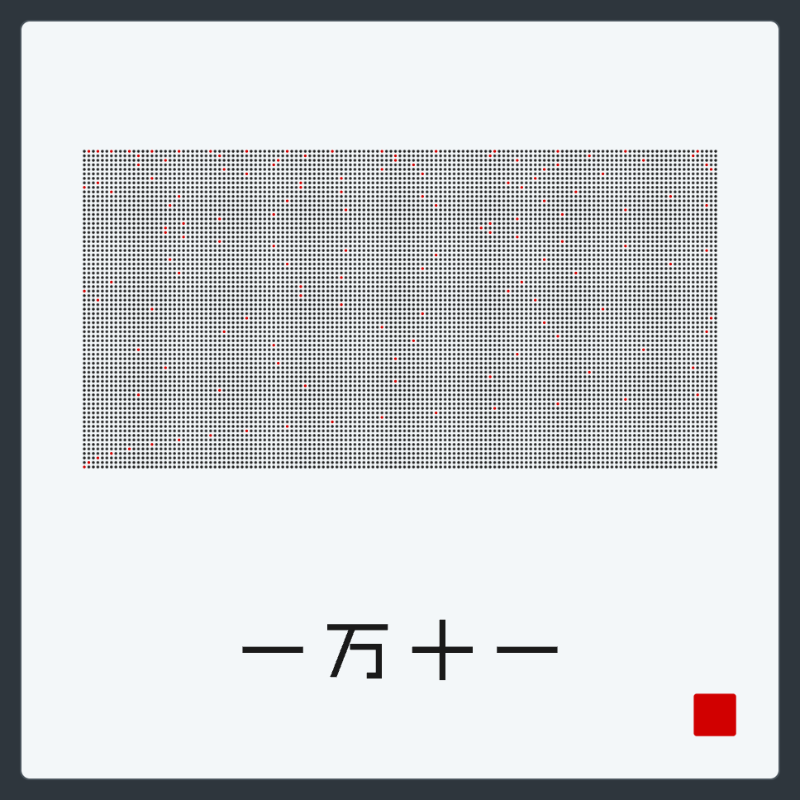
premise
a number, shown twice. as kanji, and as that many dots.
the dots — folded into the tightest rectangle that holds them. a prime cannot fold. it stays a line.
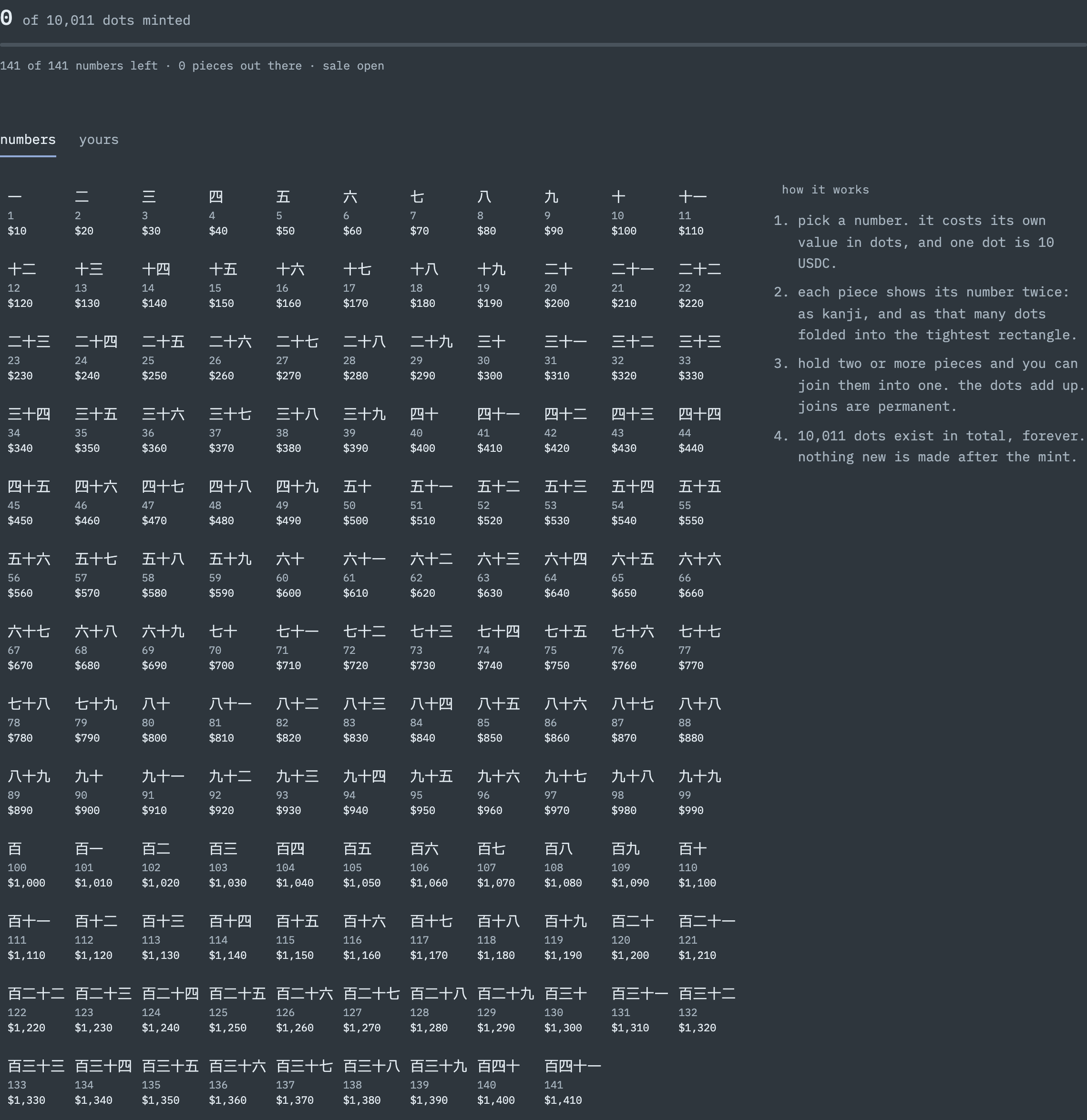
141 originals, 一 to 百四十一. 10,011 dots, forever.
nothing is made after the mint. pieces only join.
the work
name        a・count
form        141 fully on-chain pieces — one per number
range       1 … 141, each sold once
type        ERC-721 · SVG drawn by the contract · Arc
position    the count as the work
register    paper, sumi, one red
the engine
piece       a subset of the originals, stored as one bitmask
value       the sum of its numbers — also its price, in dots
fold        r × c = value, r the largest divisor ≤ √value
join        two or more pieces become one. the parts burn.
red         where one original ends and the next begins. nowhere else.
total       Σ 1…141 = 10,011 = 141 × 71. conserved through every join.
surface 05a — the number
01 · the constraint
a number is already an image of itself. count that many marks and it is there.
the work needs a rule that makes the count legible without describing it: where the marks go, what shape the count takes, what a number that will not take shape looks like.
and it needs the kanji to survive wherever the image is drawn. a thumbnail renderer without a japanese font shows empty boxes.
02 · the structural decision
one number, twice.
above: the dots. below: the numeral.
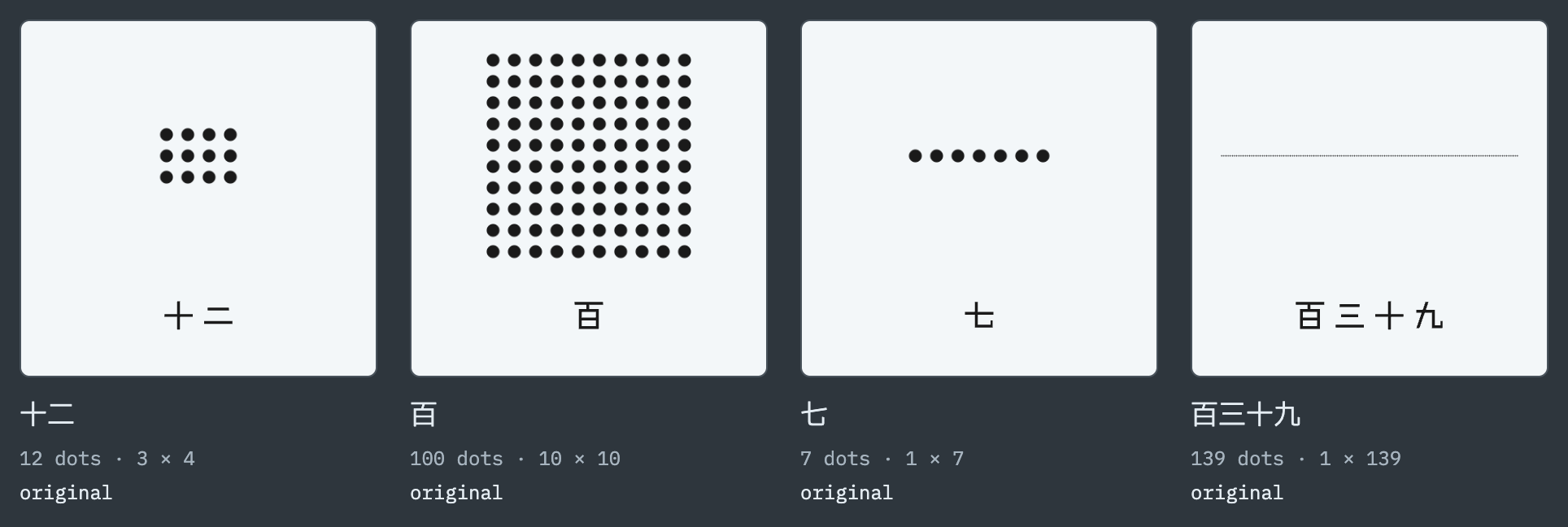
the fold is one rule. take the largest divisor at or below the square root; that many rows, the rest in columns. every row is full.
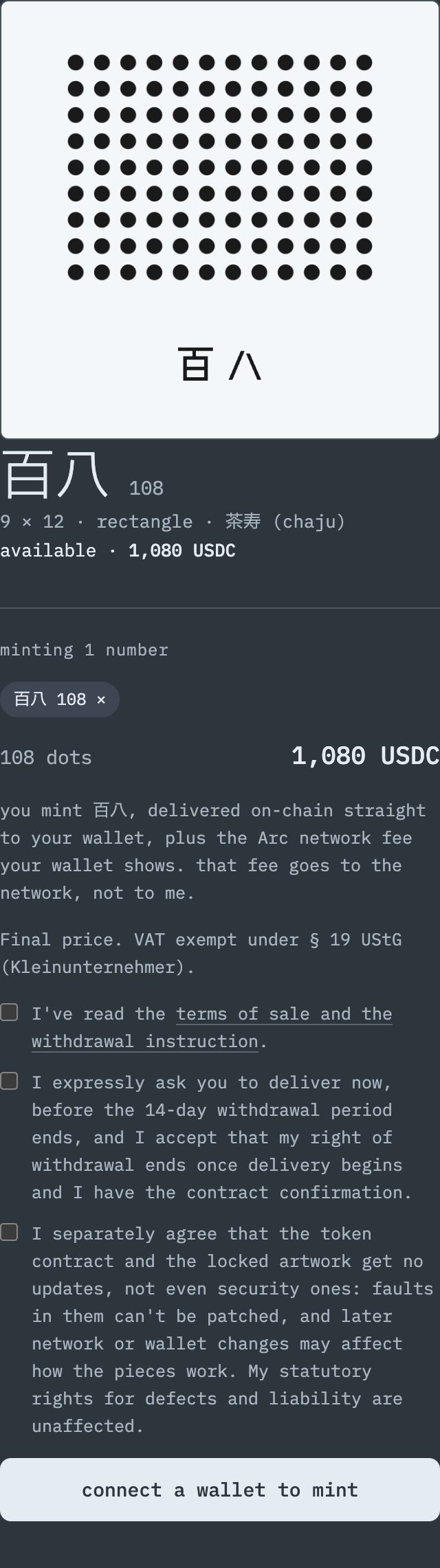
1 is a point. 100 is a square. 108 is nine by twelve. a prime has no divisor to fold on, so it lies in a single row.
among the originals: 34 primes, 11 squares, 2 perfect numbers. the fold — not chosen per piece. it is what the number does.
the dots are one rectangle filled with one repeating dot. the file is the same size for 一 and for 一万十一.
the numerals are thirteen glyphs, drawn as paths: 一 二 三 四 五 六 七 八 九 十 百 千 万. every stroke eighty units across. no font is asked for, so none can be missing.
paper, sumi, one red. an original is black on paper. red appears where a join happened, and nowhere else. the numerals stay black — red numerals read as 赤字, a loss.
03 · what it rejects
no color per number. a second accent would need a second meaning.
no <text>. the glyph is geometry, not a request to the viewer's machine.
no density cutoff. an earlier renderer drew fine folds as a solid bar, because a grid below three pixels reads as pale gray. withdrawn. every fold keeps its literal dots, at every density, including a prime's single row.
the site magnifies the same image by moving its viewBox. it never redraws the composition.
04 · evidence
05 · what it cost
the thinnest joins fall below a pixel. 10,007 dots in one row, at a thousand pixels across, is 0.083 pixels tall. outside the magnifier it shows only its numeral and its seal.
the info page says so:
As the collection approaches completeness,
certain combinations become almost imperceptible.
Nothing has been removed: every dot and every join
remains inscribed in the work.
To see them, the viewer must change their scale of attention.
at thumbnail size a dense piece fades. moiré is possible. the seal still says joined, as a shape, without depending on red.
surface 05b — the join
01 · the constraint
a collection usually grows. this one has a ceiling from the first block: 10,011 dots, and no way to make more.
what can still change is arrangement. pieces have to be able to combine without the total moving, and without a combined piece ever losing what it was made of.
02 · the structural decision
a piece — a bitmask. bit n set: original n is inside. value is the sum of the set bits.
join is or.
the masks of live pieces never overlap, so joining two is one bitwise or, and the value is one addition. the parts burn. the new piece takes the next id above 141.
at most 140 joins can ever happen. each one reduces the number of pieces by at least one.
a joined piece carries its lineage on-chain: which originals, ascending. "15 + 29".
a red dot sits where each original after the first begins, in reading order. a piece of k originals shows exactly k − 1 red dots. a red square seal, bottom right.
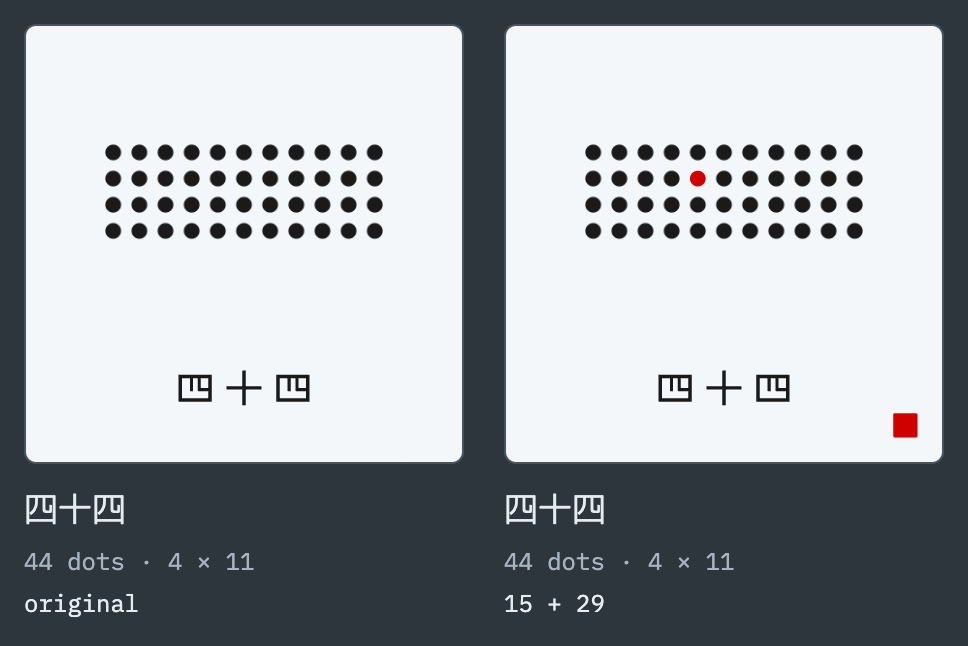
a value can repeat. an original cannot. the first two pieces worth 44 are the original, and 15 + 29.
values repeat only so far. two pieces above 5,005 would need more than exists.
everything except a set that sums to 11 makes 万, ten thousand, folded into 100 × 100.
twelve ways to leave 11 out. only one 万 can ever exist.
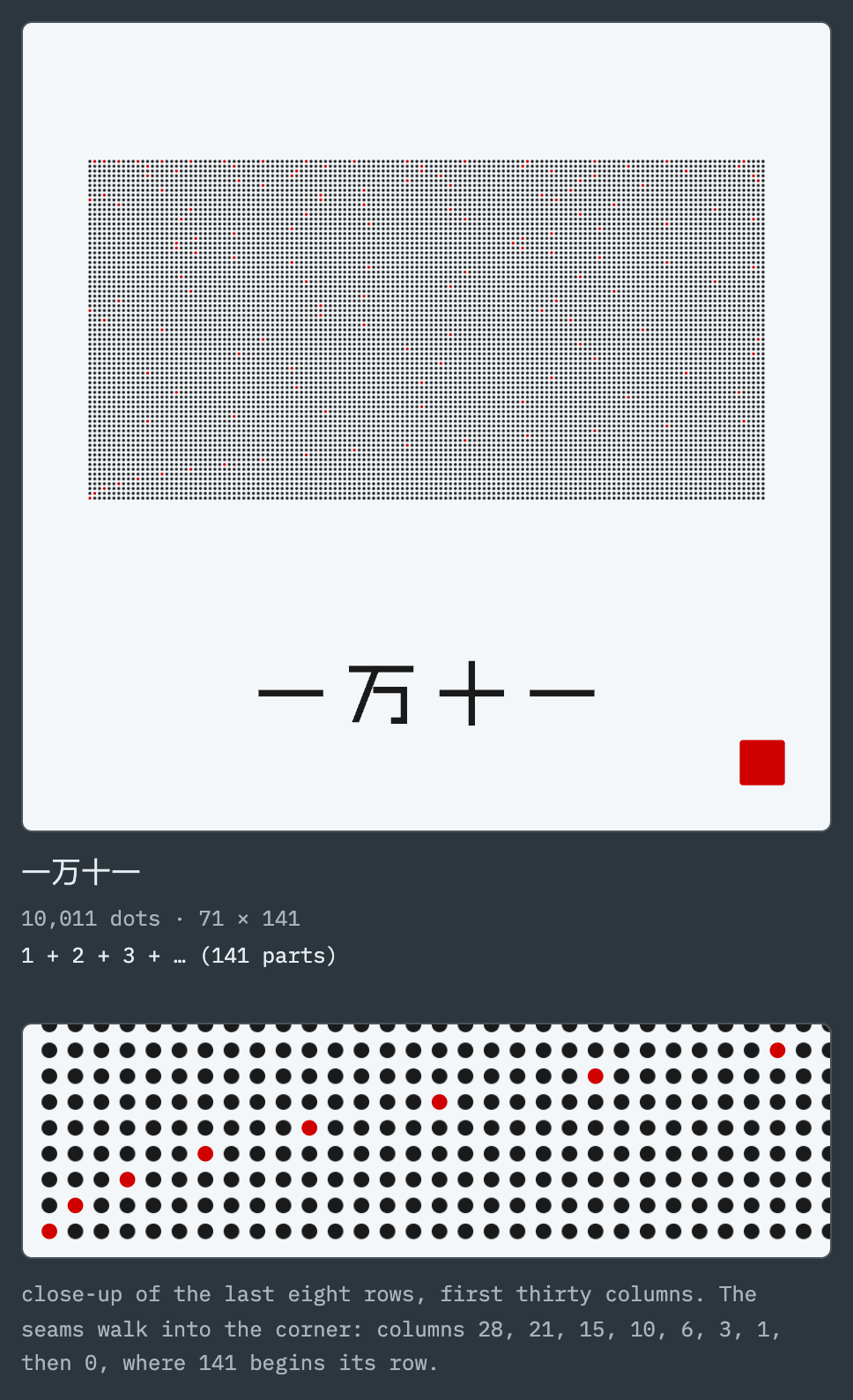
all 141 joined is 一万十一: 71 rows of 141. one side of the final rectangle is the supply itself.
1 + … + 140 = 70 × 141. the first 140 numbers fill seventy rows exactly. 141 fills the last row alone.
joins are permanent. there is no split.
03 · what it rejects
no owner mint. no proxy. no second contract that can change the first.
the renderer — locked, one way. setRenderer reverts, for the owner too. the art — final before the first sale. "no updates, not even security ones" is true when the buyer reads it.
money has one exit. withdraw sends the full balance to one immutable address, and anyone may call it. ownership can be renounced without trapping funds.
no change given. payment is exact, or the mint reverts.
04 · evidence
05 · what it cost
the first mainnet contract was retired before it sold anything.
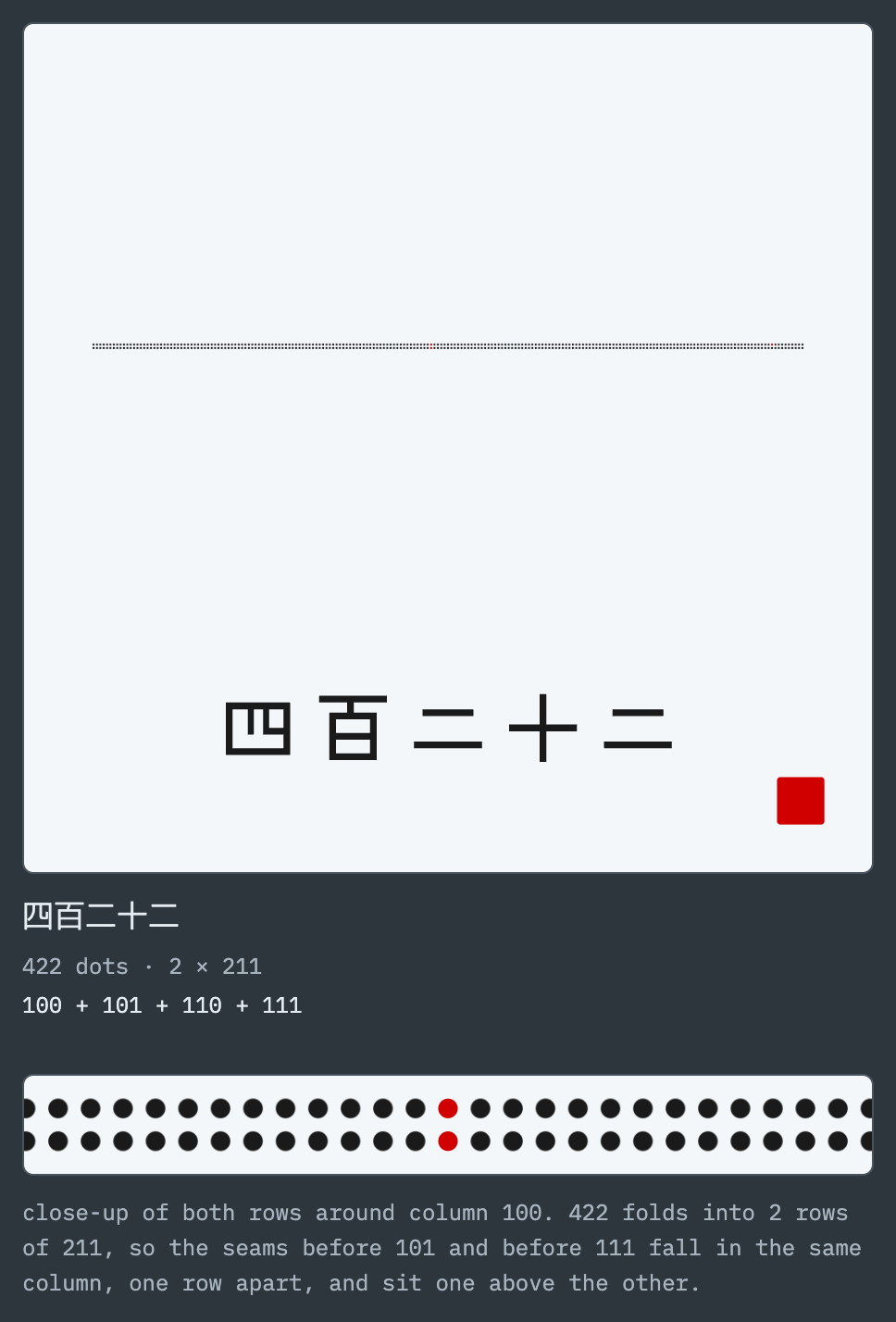
its renderer drew fine joins as bars, and a bar could put two seams on the same coordinate. 100 + 101 + 110 + 111 showed two seams instead of three. found by astra, a collaborator model.
the fix chose literal dots at every density, and that changed the locked art. so: a second deployment, checked, locked. the first had its ownership renounced from the ledger. its sale can never open. it stays on-chain as a finished draft.
the sale opened on september 22, 2026, at 00:37 UTC.
disclosure
the sale is open. a dot is 10 USDC, on arc, where USDC is the network's own currency. numbers 101 to 141 hold 4,961 of the 10,011 dots.
checkout is wallet-only. the button says buy, because the word on it must plainly mean paying. three declarations, unticked: the terms, delivery now with the right of withdrawal ending, and no updates, ever. the receipt belongs to the wallet. no name, no email, no postal address is collected.
on the chain, permanently and publicly: which wallet holds which piece, what was paid, and when. a piece whose image is drawn on-chain cannot exist without a public record of who holds it.
the twelve celebration ages inside the set — 還暦 at 60, 白寿 at 99, 茶寿 at 108 — are carried as names on their pieces.
this is not legal or tax advice.