06 · selected work
tadoru。
premise
a provenance is published as a paragraph. its punctuation already holds a structure.
a semicolon — one holder passes the object to the next. a period — no known link. a bracket — the source.
tadoru reads the paragraph link by link. where the trail breaks, the break stays visible.
the work
name        tadoru。 — 辿る, to trace back
form        a provenance reader — one page, three objects
range       three works from the art institute of chicago, public text only
type        canonical JSON · LIDO 1.1 · IIIF Presentation 3 · viewer
position    complete in sequence is not complete in evidence
register    serif and mono on a pale ground, one blue for a cited link
the engine
possession  an actor held the object, in a role, over an interval
transfer    a documented change of holder
gap         an absence of evidence. never an event.
assertion   who claims it, on what evidence, how strongly
status      documented · reported · stated · probable · possible · disputed · rejected
verified    absent. nothing here was verified first-hand.
surface 06a — the chain
01 · the constraint
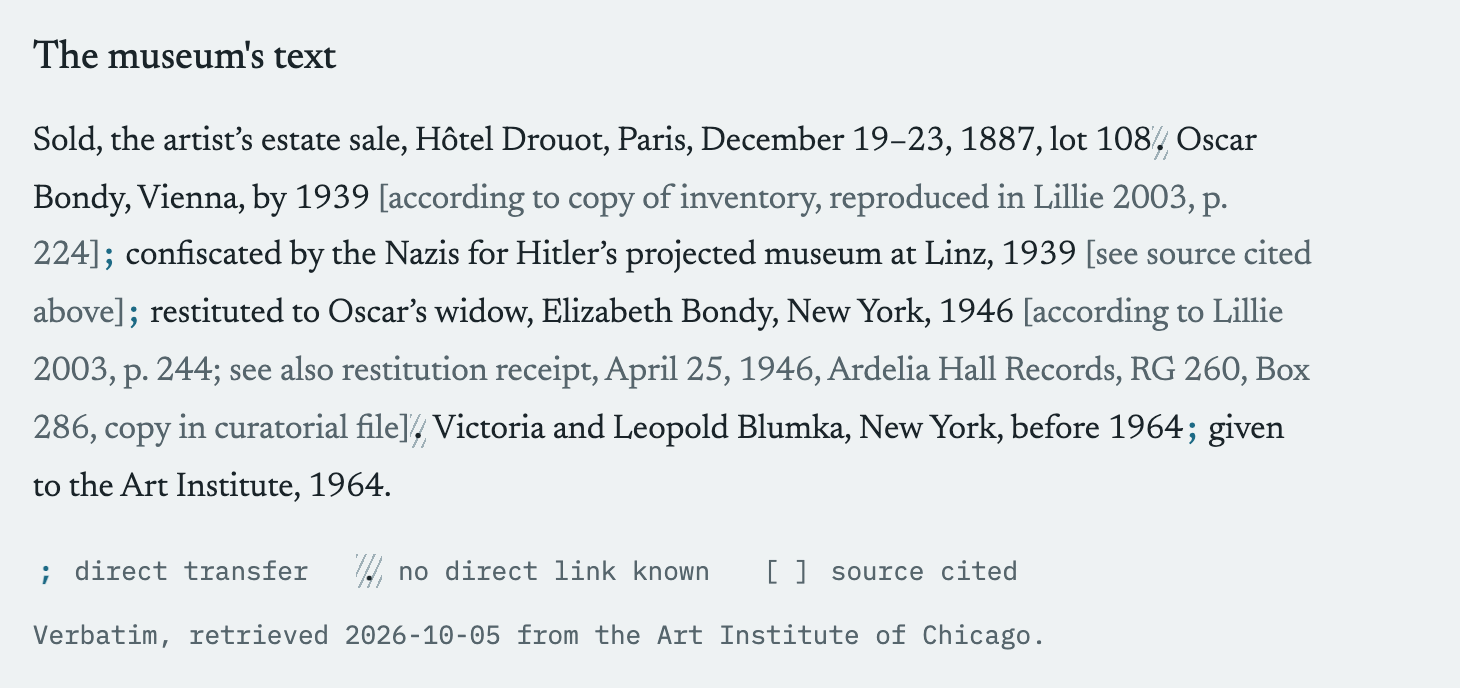
museums write provenance in a house style. at the art institute of chicago: a semicolon is a direct transfer, a period means no known direct link, brackets hold the source.
the punctuation is already a claim. a semicolon says the transfer was believed direct. it does not say how that is known.
elsewhere, brackets hold an owner's life dates. same marks —— different grammar.
02 · the structural decision
complete in sequence is not complete in evidence.
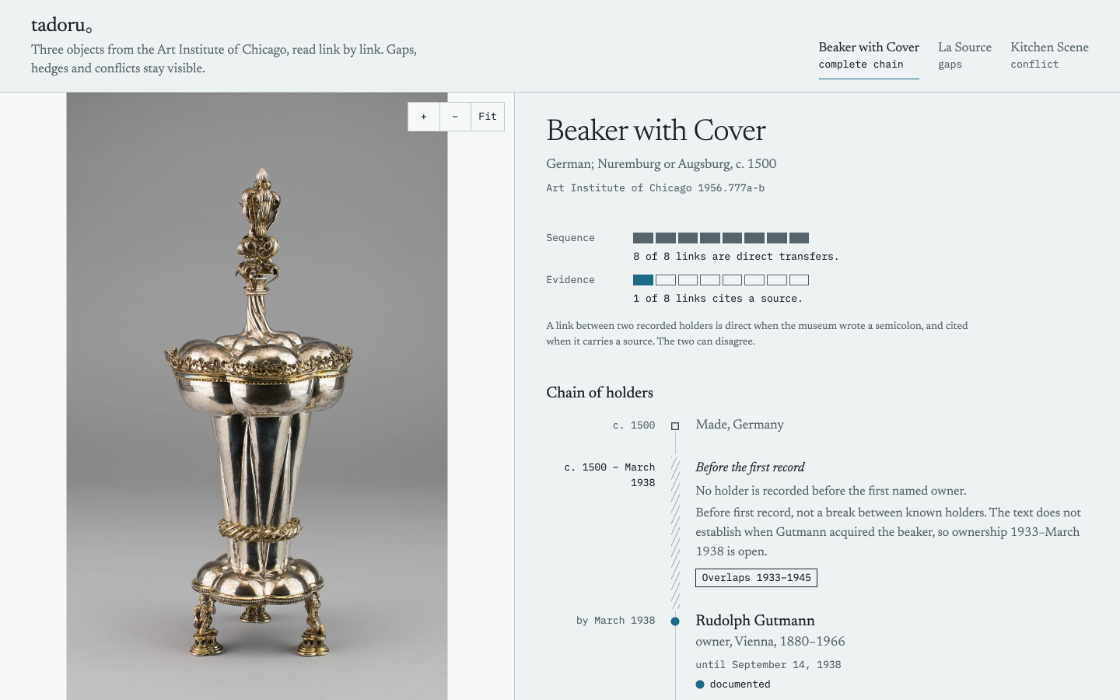
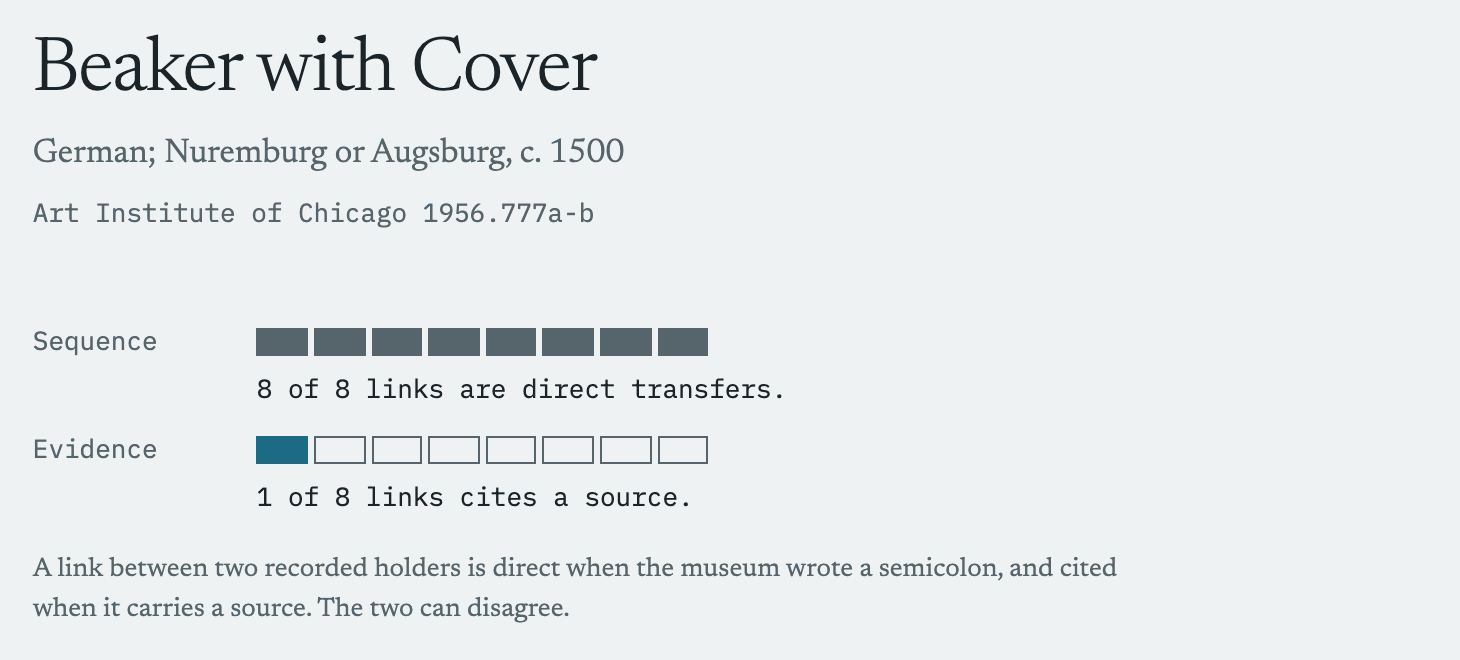
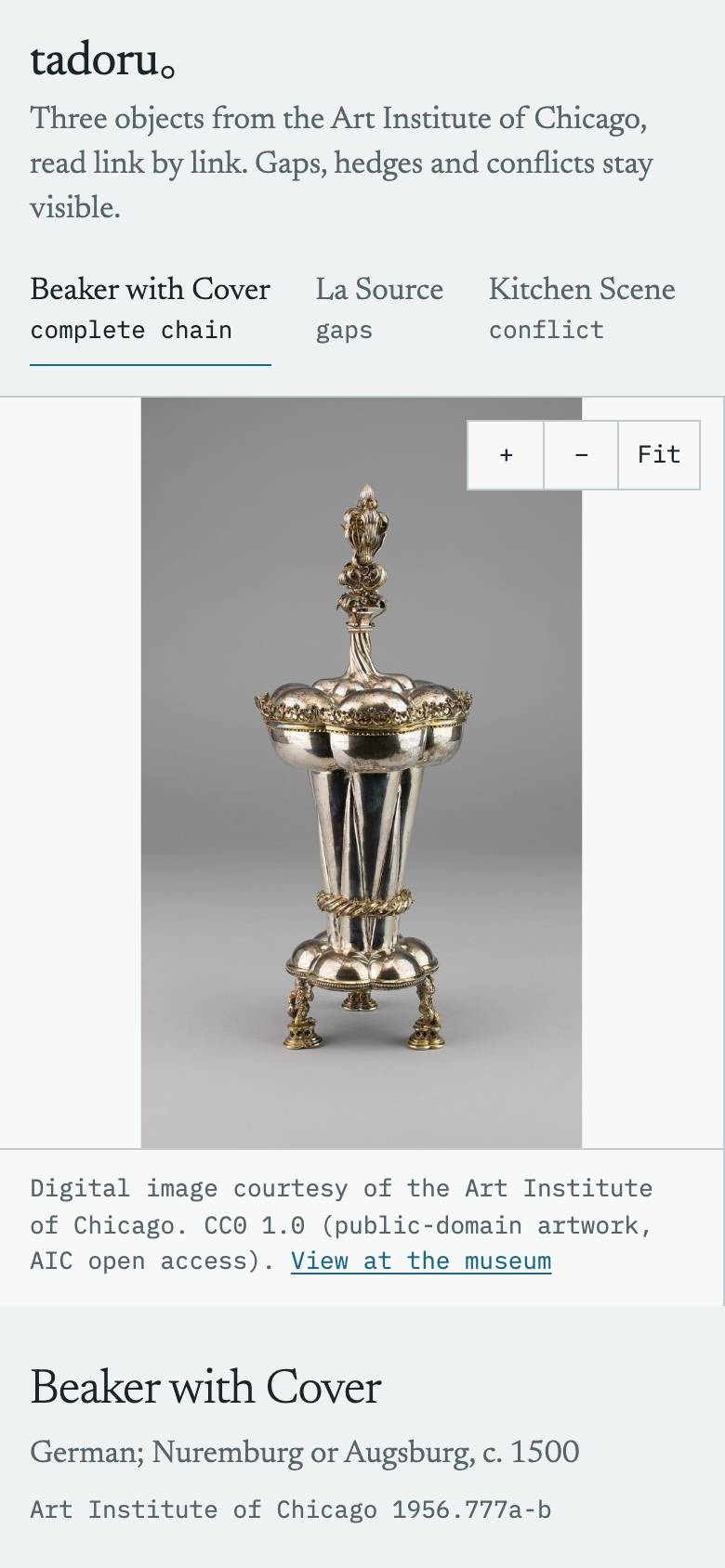
two strips, one cell per link between recorded holders: direct or gap, cited or uncited. the beaker with cover, c. 1500: 8 of 8 direct, 1 of 8 cited.
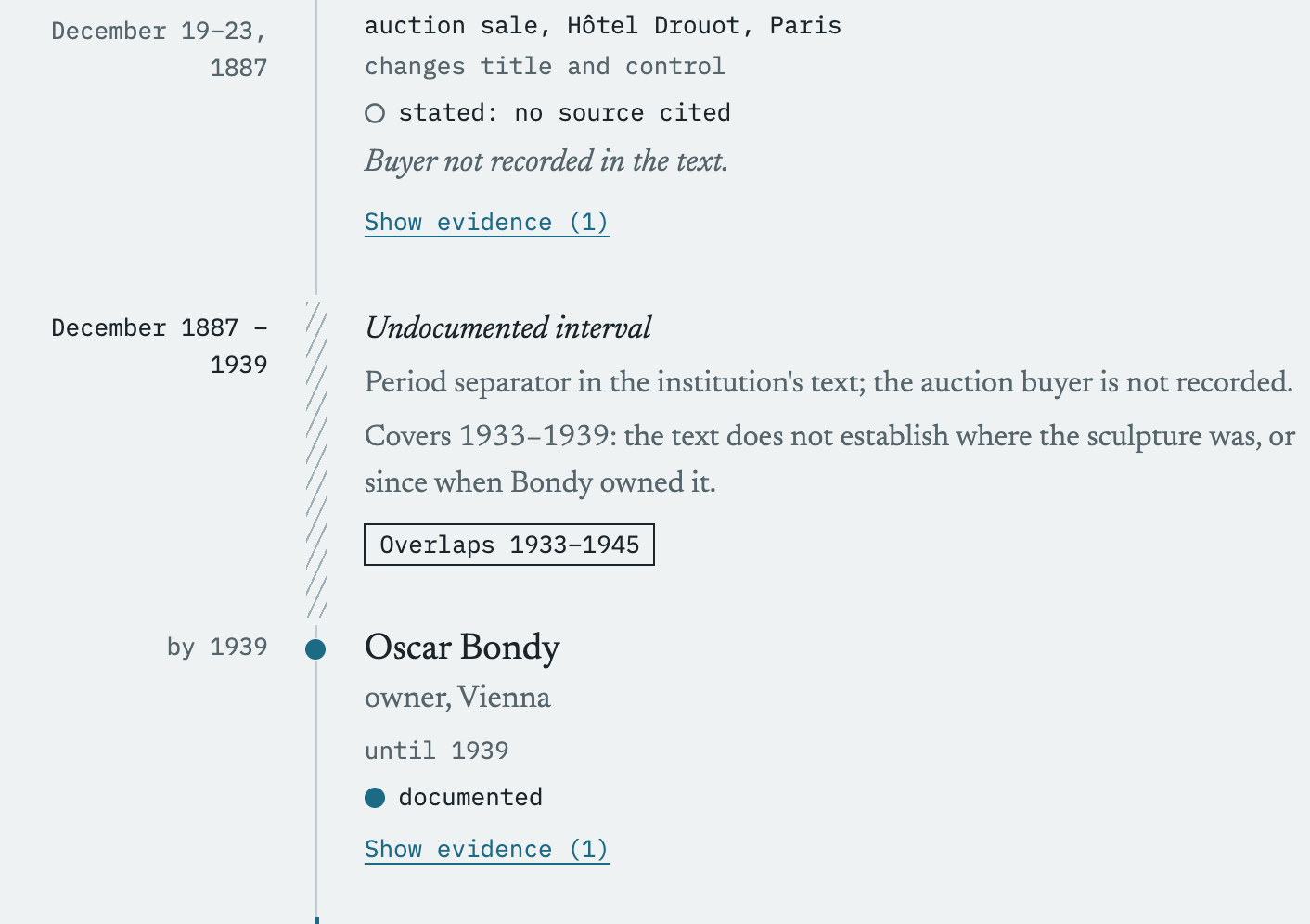
the spine is continuous only across a semicolon. a gap replaces the trace with a hatched interval of its measured length, labeled with its dates and the reason it is open.
possession is not title. a confiscation changes physical control only; title was never lawfully transferred, so a restitution returns control.
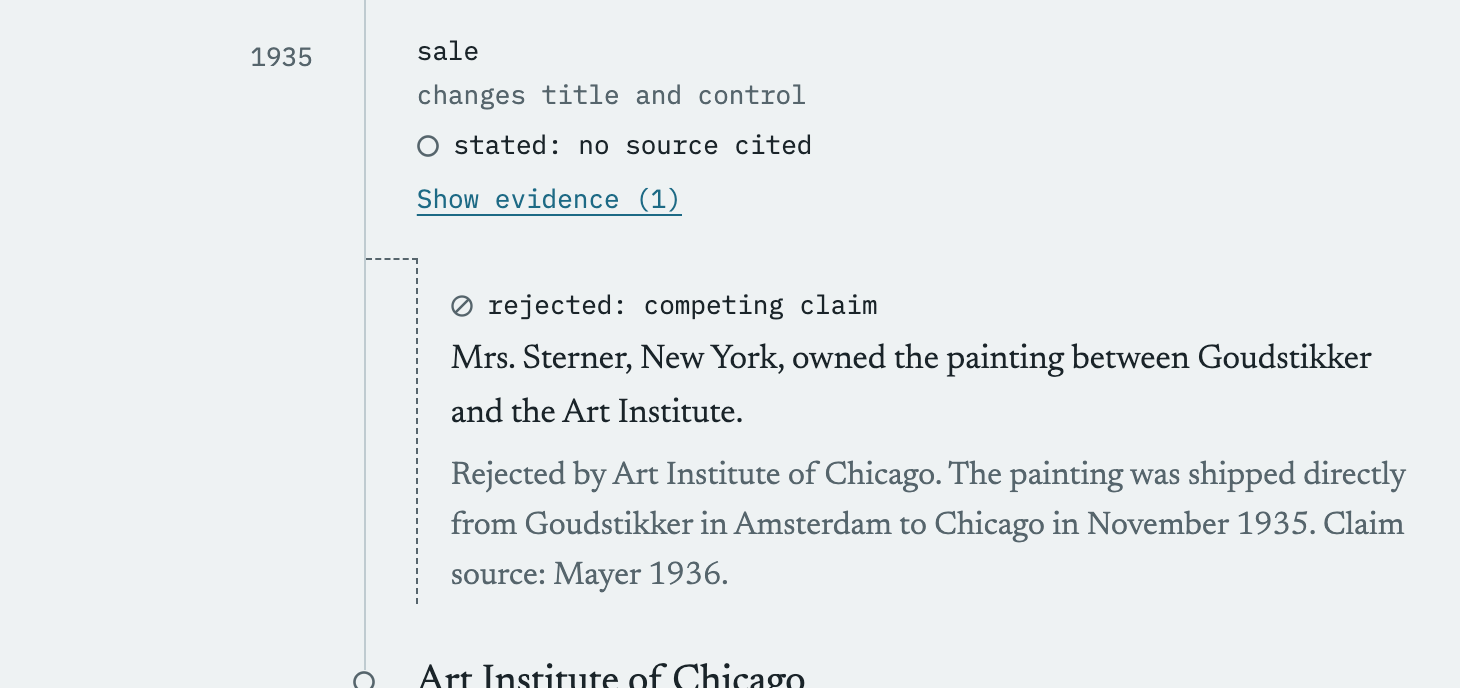
a rejected claim branches off the link it competes with — struck, with who rejected it and why.
status is always written out. the glyph's shape carries it too — filled, half, hollow, dotted, struck. color is never the only indicator.
03 · what it rejects
no "verified". the study records how strongly the museum's text supports each claim, not whether the claim is true.
no silent joins. every link between holders is a documented transfer or an explicit gap.
a gap is never an event. the validator rejects any assertion about one.
no upgraded hedge. "probably" stays the museum's word, with the museum's name beside it.
no invented holder. where the text names only a place — alt aussee, salzburg — the chain says: holder not named.
04 · evidence
05 · what it cost
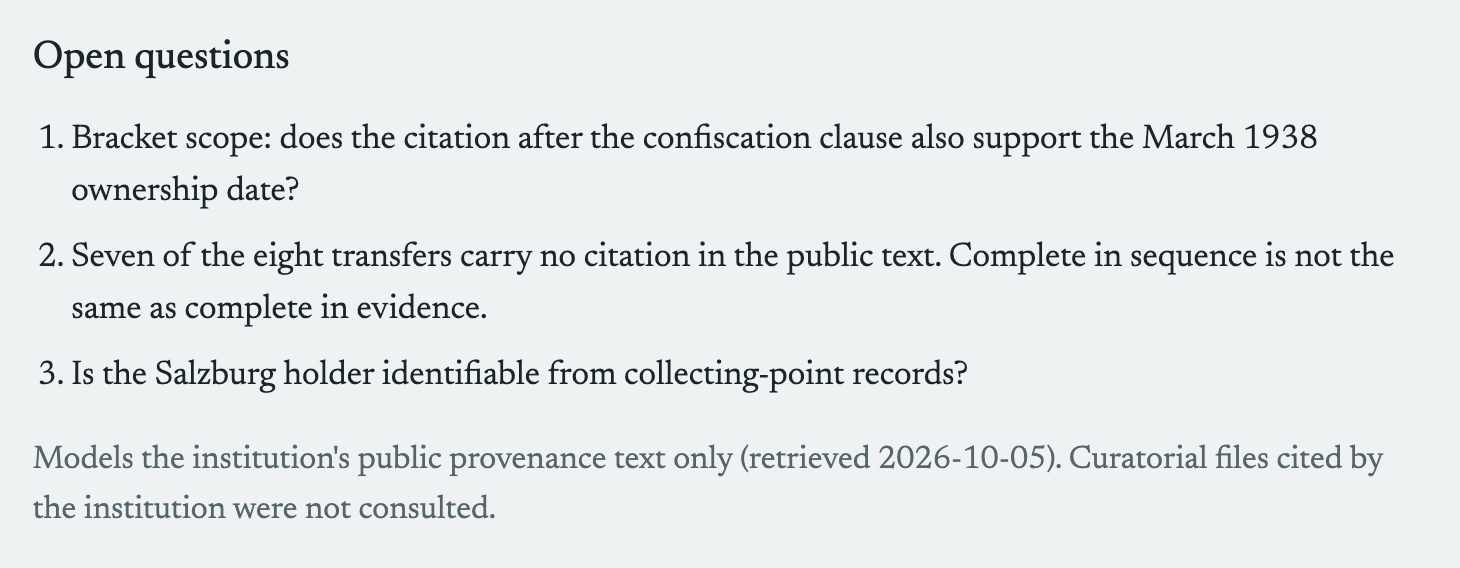
a complete chain stops looking complete. the beaker's story runs without a break, and most of it rests on the museum's word alone.
the reader is given less certainty than the paragraph seems to offer —— exactly the certainty it supports.
three objects, curated one by one. the segmenter proposes the splits; each one is decided by hand.
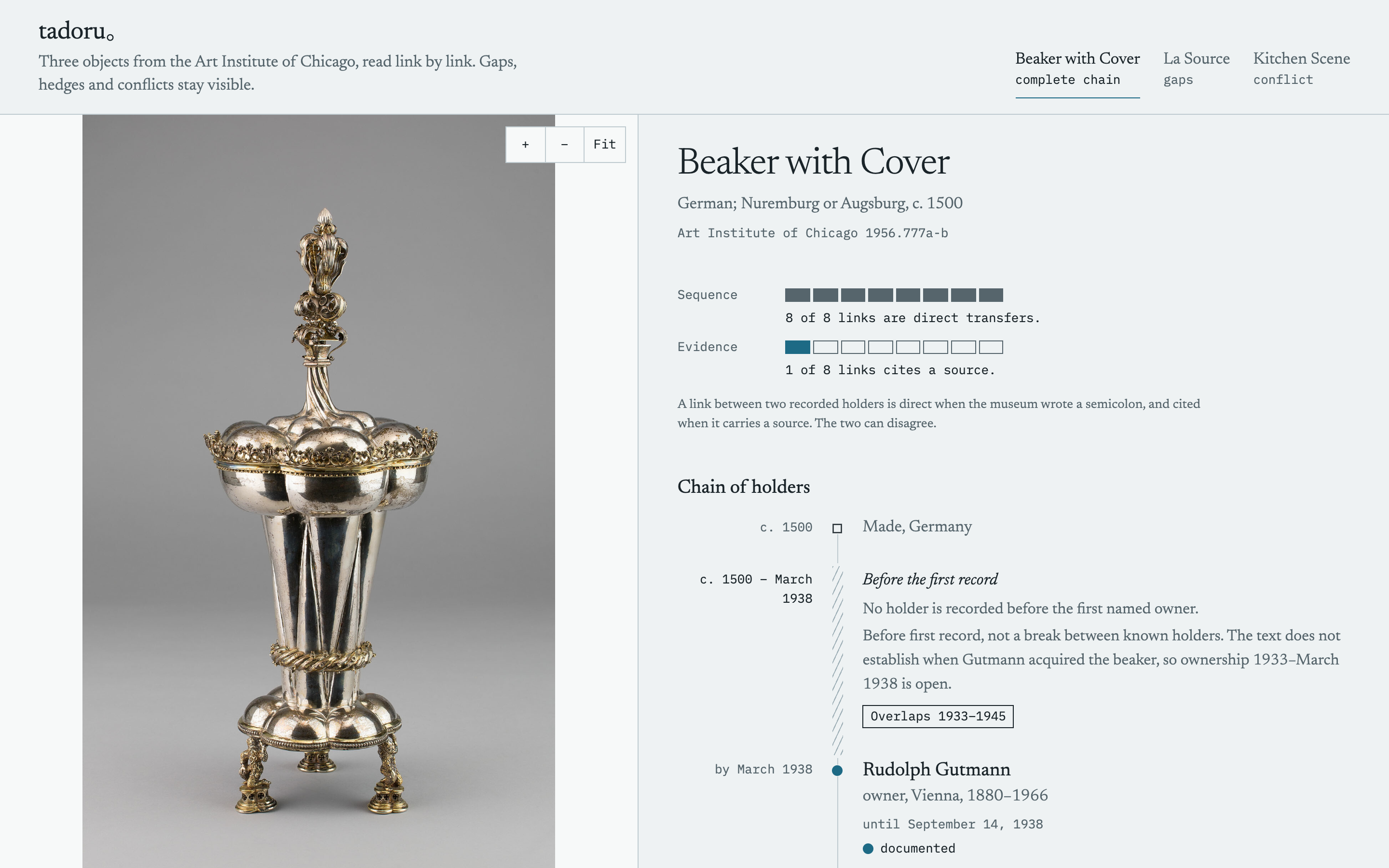
the image is the museum's own. on october 6, the museum's image host blocked the test browsers; a local copy of the public-domain image joined the fallbacks, with the attribution beneath it in every state.
surface 06b — the record
01 · the constraint
a paragraph is read by a person. museums exchange records with machines: LIDO for what is known about an object, IIIF for its images.
the records have to stand in that exchange without becoming more certain on the way.
02 · the structural decision
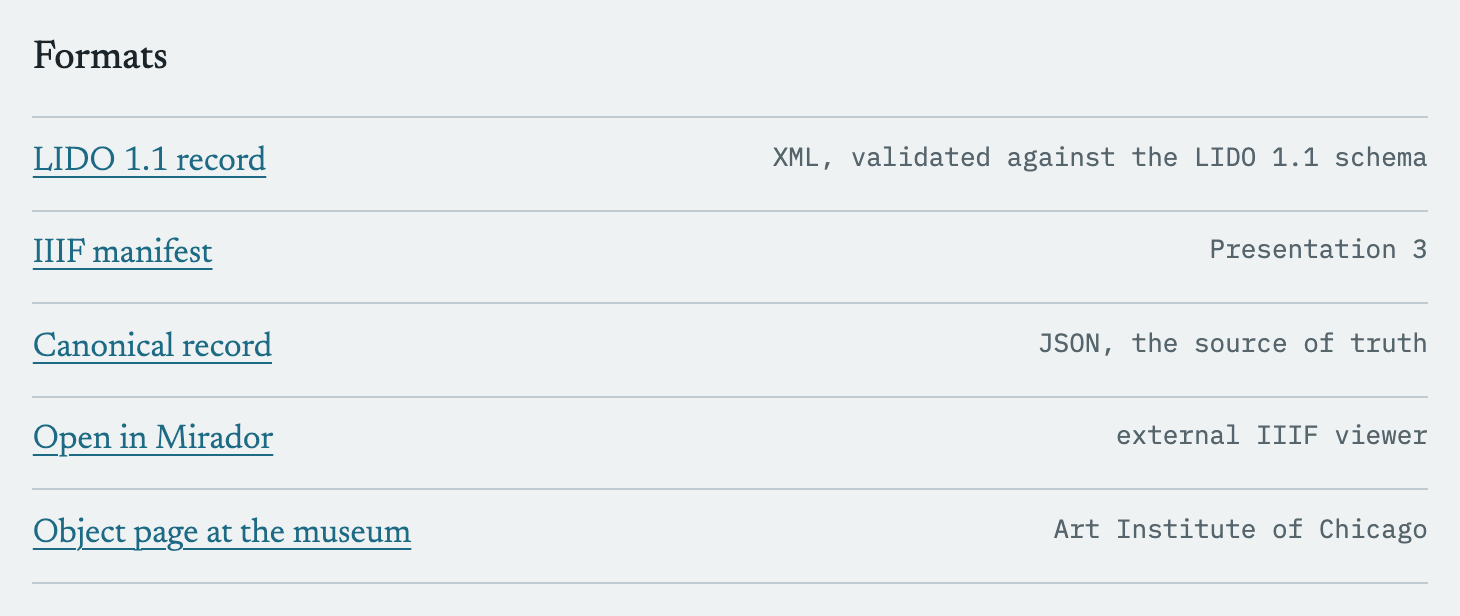
one canonical record per object — the source of truth. everything else is generated from it: the LIDO record, the IIIF manifest, the viewer.
the viewer's model is built by the same chain logic as the LIDO output. the two cannot drift apart.
only approved LIDO terms. "provenance event" is not used; LIDO now asks for the specific change. a deprecated term, purchase or gift, fails the build.
the confiscation of 1939, as the record carries it:
eventType     Change of physical control
eventMethod   confiscation
displayDate   1939
note          Modeling note: Confiscation confers possession, not lawful title.
a gap never becomes an event. it becomes a note on the event that follows, beside the museum's text, verbatim.
a rejected claim is never an event either. it stays a note on the event it competes with.
dates are EDTF. "c. 1500" is 1500~. the museum's numeric dates are search ranges — "1864" is stored there as 1859 to 1869. the record takes its dates from the text, and uses the range only where the text itself is approximate.
the museum's attribution and rights travel into every manifest. in every manifest, the image stays on the museum's own service.
03 · what it rejects
nothing beyond the public text. the archives and files the museum cites were not consulted; each is marked as known only through the museum's citation.
no CC-BY text. the museum's description field is left out; only the CC0 record is used.
no smoothing at the seam with the standard. LIDO files restitution under a change of legal title; this model holds that title never left. the output uses LIDO's term, and the record says where the two disagree.
04 · evidence
05 · what it cost
every rule has a test that feeds it a deliberately broken input. a soft record fails the build before it can ship.
the LIDO schema imports GML from the web. validating offline needed a local catalog, and a documented stub for the three elements LIDO references — the project emits no geometry.
some uncertainty has no field yet. a place written with a question mark is still open; so is a linked art export.
disclosure
the records model the art institute of chicago's public provenance text, retrieved on october 5, 2026. nothing was verified first-hand.
data and images are the museum's open access, CC0. every manifest carries the museum's line: Digital image courtesy of the Art Institute of Chicago.
two of these chains pass through confiscations, in 1938 and 1939. gaps that overlap 1933 to 1945 are flagged. the study names no rightful owner and settles no claim. it keeps the museum's text, and its gaps, legible.
the carnegie museum of art's art tracks standard is prior art; its field-scoped uncertainty is followed here.
original research, if it enters, enters as its own layer — labeled apart from the museum's text, and only after the institution has seen it.